AI-Generated Psychedelic Therapy: Innovation or AI Hype?
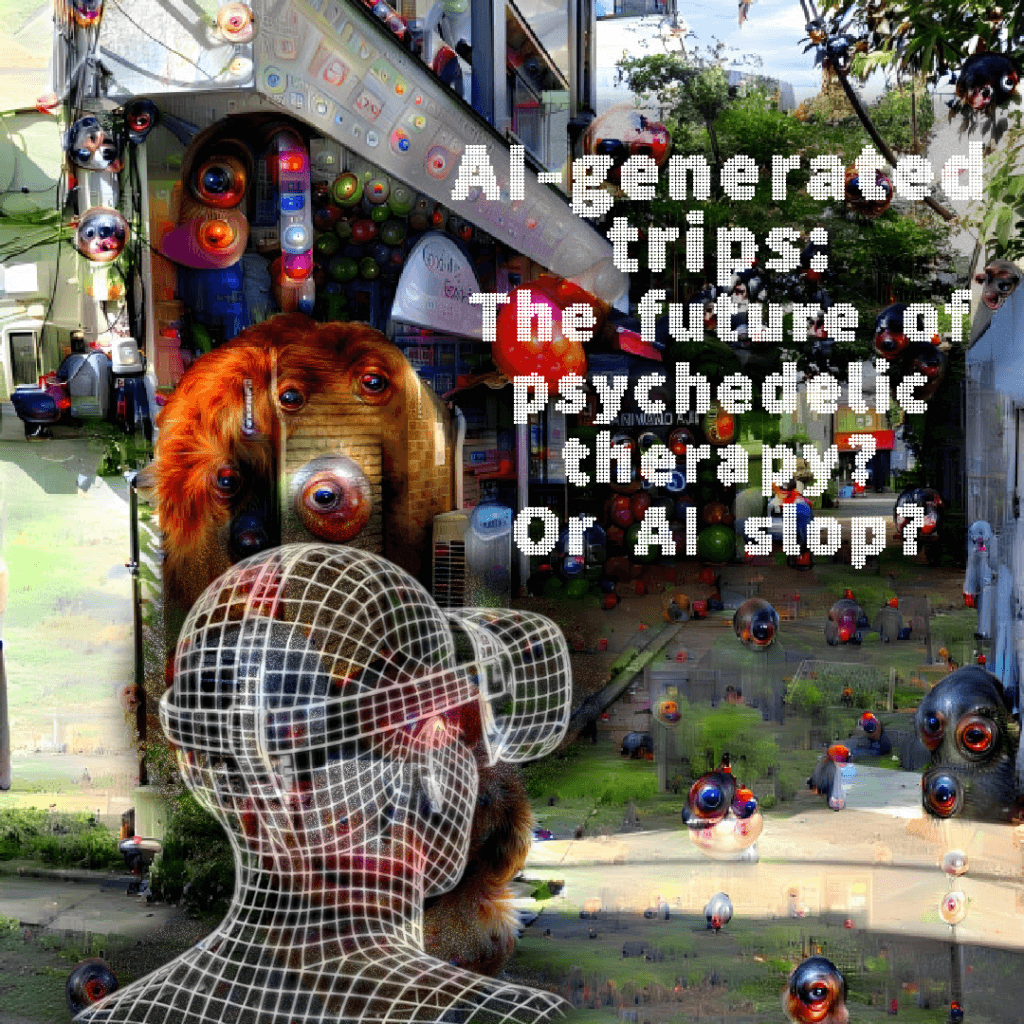
AI-generated trips: The future of psychedelic therapy or AI slop? By Goncalo V. Following last week’s article, the concept of generating trips is in its prime, arguably more than we thought, but with a different approach than the Trip Movies. The team of Giuseppe Riva, Giulia Brizzi, Clara Rastelli, and Antonino Greco presented the possibility of simulating experiences with psychedelics using AI-Generated imagery and integrating it in therapeutic frontiers. It’s undeniable that AI has made its way into our lives abruptly. At first, many were scared as Sci-Fi movies constantly warned us of a future robotic takeover — but instead, we are currently facing an intellectual takeover by the various platforms of AI. From asking ChatGPT what we should do for breakfast, to asking them to become our mentors, therapists, or even using other AI tools to generate art, there is one specific computer vision program (now also powered by AI) that has been around for decades, that has evolved to translate into something different, to create images using convolutional neural network to find and enhance patterns in images using algorithmic pareidolia, creating a dream-like appearance that reminded users of a psychedelic experience by generating over processed images, a program which the Google engineer Alexander Mordvintse named DeepDream. Shulgin Farm- Image by the Shulgin Foundation DeepDream version of the image While some images may seem an overkill when it comes to computer generation, as typically, psychedelic trips can be far more subtle when it comes to changing our visual perception of things, the example shown above, is obviously one of the most overkill examples, DeepDream also provides us with options far more subtle that could resemble what people would perceive the world in highly visual hallucination inducing compounds such as DMT including some geometrical shapes and kaleidoscopic features. Such resemblances between the visuals in psychedelic trips and the images generated by DeepDream were what fueled the research by Giuseppe Riva, Giulia Brizzi, Clara Rastelli, and Antonino Greco — by picking up the engine that allowed people make trippy images for decades, we could now allow people to experience “psychedelic visuals” without actually having to take the compound. For those who love researching psychedelics: Apparel Researching Psychedelics Embroidered Vintage corduroy cap $45.00 Apparel Researching Psychedelics Embroidered Unisex Hoodie $80.00 Apparel Researching Psychedelics: Embroidered Unisex Sweatshirt $65.00 Apparel Researching Psychedelics Embroidered Short-Sleeve Unisex T-Shirt $45.00 Now they only needed to find one answer: how can we make this experience immersive to the user without feeling like we are just staring at an LCD or AMOLED screen, and how does this translate into replicating an actual psychedelic trip? To achieve an answer to these questions, the team picked on the concept on how, during VR experiences, the brain attempts to predict the sensory consequences of an indivual’s movements providing them the same scene they will see in the real world, therefore, the brain maintains a model (in this case, the simulation) of the body and the space around it. But how would this play out in the real world? Can changing realities affect our neurochemistry and have real therapeutic effects? To the surprise of many, messing up with how we view the world, even if it is for a short period of time during a VR session, modifies the same predictive coding mechanism that makes classic psychedelics therapeutically effective, and the team noticed that participants exposed to these AI-generated experience demonstrated increased cognitive flexibility, additionally, the experiences reduced positive affects and state of anxiety, reduced heart rate and sympathetic activity compared to baseline. Such changes appear to work by modifying the same predictive coding mechanism that makes classic psychedelic therapeutically effective. Write with us Our mission is to educate about psychedelics. Whether you’re sharing your personal journey, exploring science, or crafting tales of transformation, your voice matters here! Pitch us your idea via email These predictive coding mechanisms enable the brain to function as a predictive machine by constantly generating predictions about sensory inputs, thereby balancing previous beliefs and incoming information. According to the REBUS model, psychedelics induce a relaxation of rigid priors, which are primarily mediated by the 5-HT2A receptors; the imbalance between what is expected and what is coming leads then to hallucinations. Considering the concept of similarities between simulated and substance-induced hallucinations of perception, emotional responses, and cognitive flexibility, there is a chance that “Cyberdelics” could have a similar effect, that the nature of AI-generated content could cause a temporary recalibration of the precision weighting process, and sensory data are considered more reliable than priors. Thus, allowing “Cyberdelics” to facilitate a form of cognitive relaxation that aligns with the principles of the REBUS model. https://www.youtube.com/watch?v=AaTjty1unn8&t=2783s The pros and cons: If “Cyberdelics” are proven to work, they could be a solid foundation for future psychedelic therapy, as they: Don’t require a prescription. There are no legal barriers stopping this research. Waiting lists should be minimal. Every session can be customized. Previous patients can revisit prior “trips” and access them as therapeutic material post-experience. The cons: The amount of exposure needed for a lasting change is unknown. It’s unknown whether these experiences can have a therapeutic effect without the guidance of professionals. Integration in the psychedelic community and general society: When talking about psychedelic experiences, or taking psychedelics, the most predominant idea that automatically pops into people’s minds is the crazy visuals, the mind-bending perceptions of reality, the epiphanies that will make you rethink every choice you made in life, re-live it, and allow you to change your perception of life or even meeting God or other spiritual entities that will uncover and decode the secrets of the world to you. While this can sometimes happen, we must question ourselves whether these visuals are the only thing relevant when it comes to a psychedelic experience. To do so, we invite you to read one of our previous articles regarding how blind people react towards the effects of psychedelic compounds (Read here) We also wanted to
AI-Generated Psychedelic Therapy: Innovation or AI Hype? Read More »