Can Blue Lotus still make you lucid dream?
By Goncalo V.
Egyptian Blue Lotus (Nymphaea Caerulea) had an impact in Ancient Egypt as a symbol for life, immortality, and resurrection due to its association with the God of Sun Ra (associated with life, rebirth, and the cycle of the sun), but also as a tool to connect with the Divine, to introduce higher states of consciousness and promote lucid dreaming. For this reason, the plant played a significant role in their ceremonies, which were first documented around 1250 BCE, in the Papyrus of Ani. (Blue Lotus would also be used as an ancient party drug, its euphoric effect, promoting relaxation, and improvement of circulation, characterized this plant as a potent aphrodisiac to sexually themed parties and religiously charged orgies.)
Don't miss our New Lucid Dreaming Collection


Ani transcript:
“As if I’d slept a thousand years underwater, I wake into a new season. I am the blue lotus rising. I am the cup of dreams and memory opening–I, the thousand-petaled flower. At dawn, the sun rises naked and new as a babe; I open myself and am entered by light. This is the joy, the slow awakening into fire as one by one the petals open, as the fingers that held tight the secret unfurl. I let go of the past and release the fragrance of flowers.
I open, and light descends, fills me, and passes through, each thin blue petal reflected perfectly in clear water. I am that lotus filled with light reflected in the world. I float content within myself, one flower with a thousand petals, one life lived a thousand years without haste, one universe sparking a thousand stars, one god alive in a thousand people.
If you stood on a summer’s morning on the bank under a brilliant sky, you would see the thousand petals and say that together they make the lotus. But if you lived in its heart, invisible from without, you might feel how the ecstasy at its fragrant core gives rise to its thousand petals. What is beautiful is always that which is itself in essence, a certainty of being. I marvel at myself and the things of earth.
I float among the days in peace, content. Not part of the world, the world is all the parts of me. I open toward the light and lift myself to the gods on the perfume of prayer. I ask for nothing beyond myself. I own everything I need. I am content in the company of god, a prayer that contains its own answer. I am the lotus. As if from a dream, I wake up laughing.”
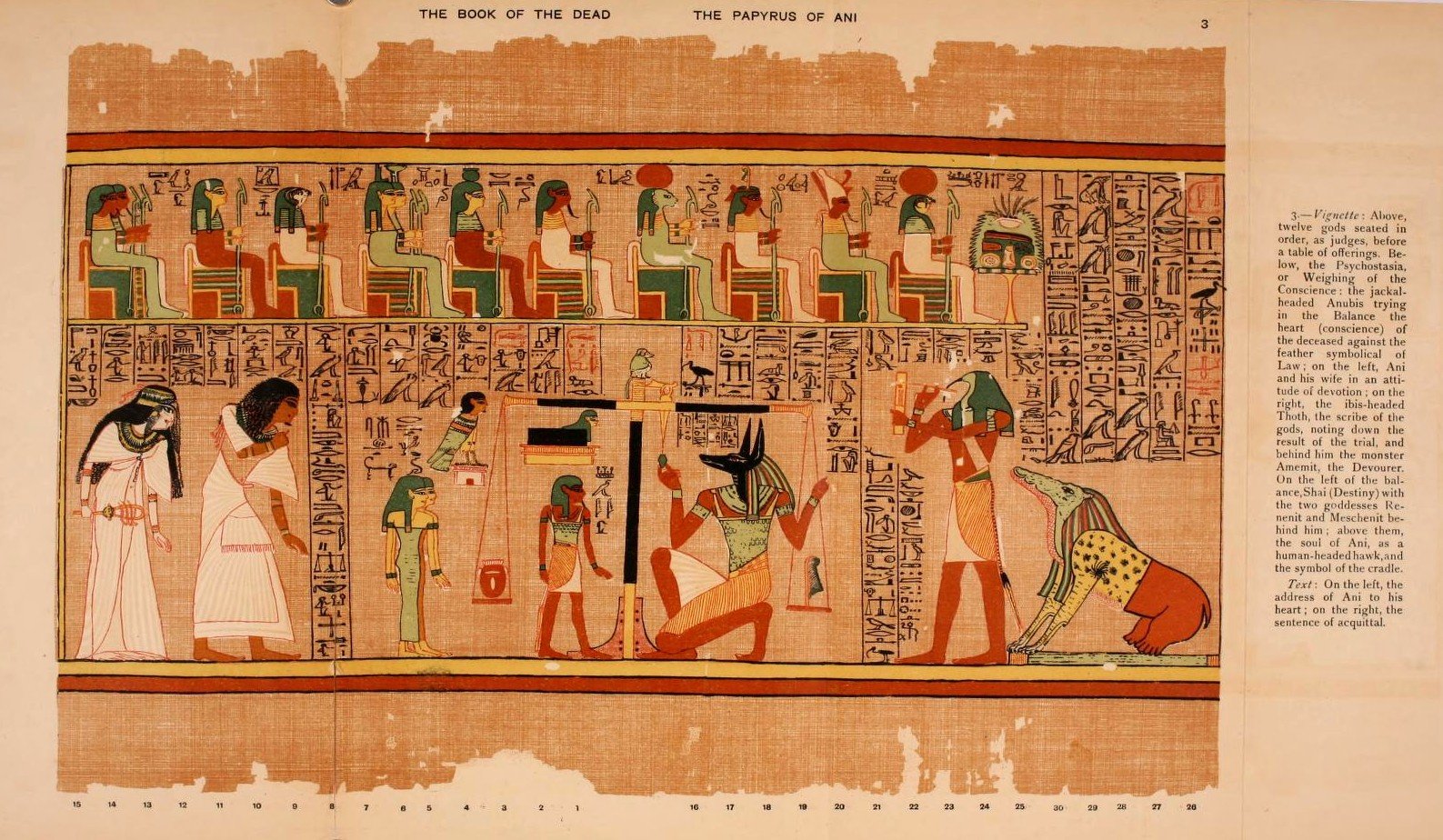
This connection goes beyond these beliefs to actual connections with the Gods. Nefertem is strongly associated with the flower — it’s said that he emerged from the primordial waters in the Lotus itself. The “psychedelic” effects of the plant may also have a connection with Gods like Bes, represented as a dwarf with a large head, goggle eyes protruding tongue, bowlegs, bushy tail and a crown of feathers, reported in the Chester Beatty Papyrus considered to be the oldest book in history, is believed to be the god responsible for protecting households in particular mothers, children and childbirth and dreams and Tutu, an anthropomorphic creature consisting of the striding winged lion, human head, and the tail of the serpent, considered to be a dangerous goddess, for its power over the demons, Tutu is believed to guard the sleeping against danger or bad dreams, several offerings and altars were created to protect people from demons and bad dreams.
According to Ani, Egyptians also believed that once transformed into a lotus, they could be in the company of the Gods.
Ani Transcript:
“Chapter of making the transformation into a lotus:
The Osiris, the lady of the house, Aui, whose word is truth, in peace, saith:- Hail, thou Lotus, thou type of the god Nefer-Temu! I am the man who knoweth your names. I know your names among the gods, the lords of Khert-Neter. I am one among you. Grant ye that I may see the gods who are the Guides of the Tuat. Grant ye to me a seat in Khert-Neter, near the Lords of Amentet. Assign to me a habitation in the land of Tchesert. Receive ye me in the presence of the Lords of Eternity. Let my soul come forth in whatsoever place it pleaseth. Let it not be rejected in the presence of the Great Company of the Gods.”
We need your help
We are currently working on our second book, Entheogenic Synergy. To do so, we need your help. By sharing your psychedelic experience, you will be helping us immensely with our study to prove the theory that external factors before the psychedelic experience can impact the way we trip. You can share your psychedelic experience by accessing our form.
Egyptologists believed that the Blue Lotus flowers were mixed with wine and shared with others partaking in the rituals for decades. This method has been passed down through personal and online reports, as well as by sellers selling Blue Lotus products. Macerating the Blue Lotus flowers, or making a tea from the dried plant, is still considered the go-to method for many users. Yet for some reason, when we read user experiences regarding Blue Lotus or Blue Lotus products, lucid or vivid dreaming experiences seem to be rather mixed.
Leaving us to question:
But how does this impact your experience with the Blue Lotus, you may ask?
Liam McEvoy, a fourth-year UC Berkeley student majoring in anthropology and minoring in Egyptology, decided to reach the rock bottom of why the plants used in ancient Egypt and the water lily advertised online are completely different plants, and how this portrays the different experiences reported during that era and today’s experiences in the lucid dreaming and psychonaut community.

For this, he decided to collaborate with the UC Berkeley Center for the Science of Psychedelics to compare authentic plants growing at the UC Botanical Garden with samples sold online in marketplaces like Etsy.
To everyone’s surprise, not only was their chemistry different, but they are entirely different species. Additionally, Egyptologists may have misunderstood how the psychoactive blue lotus was consumed thousands of years ago, according to McEvoy.
“I wanted to let the plant tell its story and contribute to a discussion where there’s all this pseudoscience floating around — pseudoscience that makes some people a lot of money.” -Liam McEvoy.
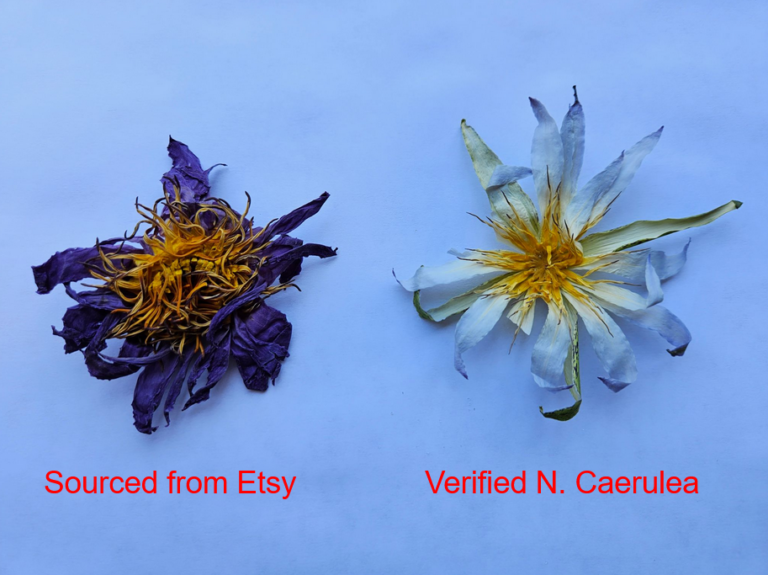
Alongside Evan Williams, a Berkeley professor of Chemistry, and Anthony Iavarone, a project scientist, McEvoy used mass spectrometry to compare the chemical composition of the Etsy-ordered product with the UC Botanical Garden sample.
After analysis, they found that the Nuciferine levels were higher in verified Egyptian Blue Lotus than in the online-bought product, leading McEvoy to believe that while visually similar to the Egyptian Blue Lotus, the flowers sold online are non-psychoactive water lilies.
But how does this impact your experience with the Blue Lotus, you may ask?
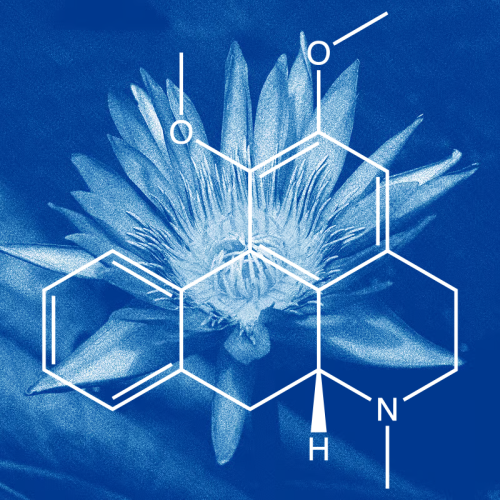
Nuciferine is one of the two main compounds previously found in Blue Lotus products that allow the Egyptian Blue Lotus to cause the reported effects of higher states of consciousness and lucid/vivid dreaming. (We will get back to this statement further in this article). The compound interacts with various receptors in our brain, each with its own effects.
Majorly, the compound acts as:
- A partial agonist at certain dopamine receptors (D2 and D5) and an inhibitor of the dopamine transporter. This activity, along with its metabolite atherosperminine, influences dopamine signaling in the brain, contributing to mood elevation and a sense of well-being.
- Interacts with various serotonin receptors, acting as an antagonist at some (like 5-HT2A) and a partial agonist/agonist at others (like 5-HT1A and 5-HT6). The modulation of serotonin activity plays a role in the altered perception and dream-like states reported by users.
- For this reason, Nuciferine is often described as having an antipsychotic-like effect, promoting a deep sense of tranquility and relaxation, which counters anxiety and can aid sleep.
How Ancient Egypt might have actually used the Blue Lotus:
The next thing McEvoy wanted to set straight was whether it would be possible to extract the psychoactive compounds of the plant using the same methods Egyptologists claimed people in Ancient Egypt would use, by soaking the plant material in red wine and drinking the concoction.
While typically this method (maceration) works and has been used in hundreds of concoctions in human history, when it comes to the extraction of plant alkaloids (and would even work in pure, chemically isolated nuciferine), the task becomes extremely challenging when it comes to a waxy, water-repellent exterior like the one present in the Egyptian Blue Lotus.
To overcome this issue, the team decided to use a substance similar to olive oil that would allow the slightly fat-soluble alkaloid to dissolve in wine.
“We’re beginning to think the ancient Egyptians didn’t just put it into wine….We hypothesize they actually created an infused oil, which was later added to wine.”
-Liam McEvoy

Our breakdown of what might be happening in certain Blue Lotus products:
Such discoveries change our understanding of the use of Blue Lotus in Ancient Egypt. But also make us question the lotus-laced supplements available today and our methods of consumption. Could it all be a product of a placebo effect?
To reach an answer, we must analyze the products being sold to conclude what most products actually are, and go back to the quote we mentioned above:
By doing a visual comparison between the species ordered online, we can deduce that the species ordered online is, in fact, closer to the dried Nymphaea stellata (nowadays Nymphaea nouchali var. nouchali upon the taxonomic change in nomenclature) and not Nymphaea caerulea, a botanical variety of Nymphaea nouchali, so here is where they trick you!
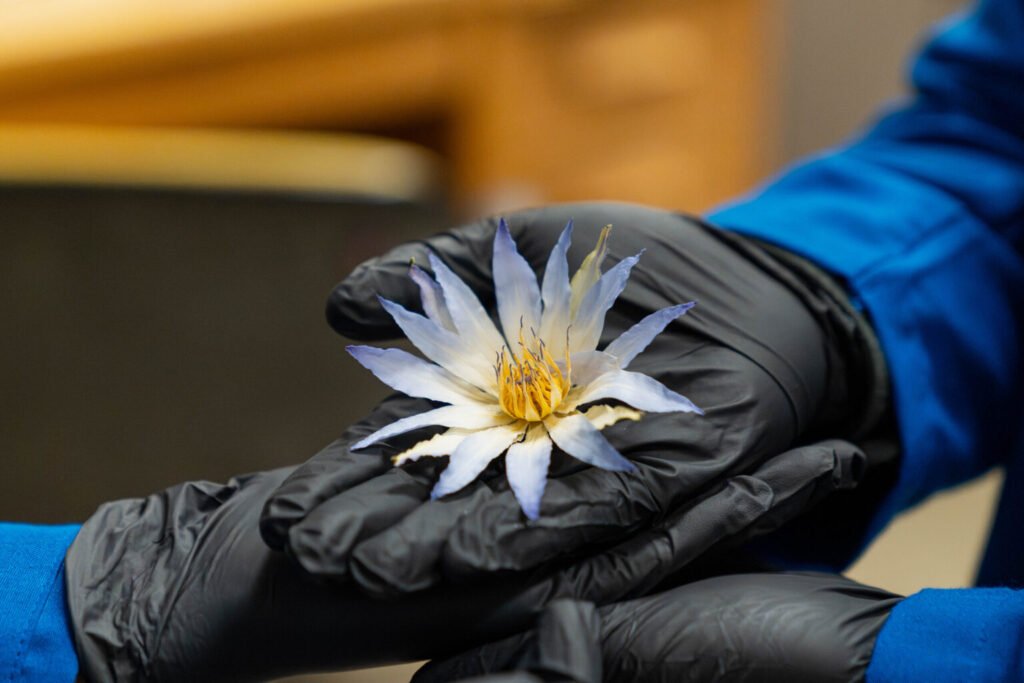
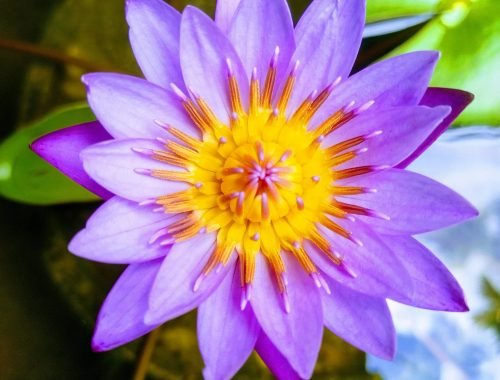
And when decoding the chemical composition of these so-called “Blue Lotus products”, various studies have recently found that Nuciferine was virtually absent in the blue lotus extract. Leading to the belief that solely the botanical variety Caerulea holds a significant percentage of Nuciferine, providing such states and lucid dreams. Yet this mystery is far from being over, as we must go back to one of our quotes:
“Nuciferine is one of the two main compounds previously found in Blue Lotus products that allow the Egyptian Blue Lotus to have the reported effects in the Papyrus of Ani.” The second main compound would be Apomorphine, which wasn’t mentioned at any point in Liam McEvoy’s research. This could be for a simple reason: the analysis focused on the differences between nuciferine percentages in the plant species and products sold online, given that Blue Lotus itself only produces nuciferine naturally, and does not produce Apomorphine.
The short answer is that it’s impossible to know why some Blue Lotus supplements contain such alkaloids, but we do have some hints…
Apomorphine is a semi-synthetic compound and is not known to be biosynthesized by any plant or organism. Typically, to achieve such a molecule, chemists chemically modify a natural compound, morphine, via acid-catalyzed dehydration and rearrangement, leaving us with only two options:
- Sellers induce synthetic Apomorphine when making these e-liquids, or bathe the flowers/resins in synthetic Apomorphine.
Or
- They introduce the compound into the soil when growing these plants (we’ve seen a similar case in “Psilomethoxin”, read more here!)
The same can be said after McEvoy’s findings; it would only be fair to say that the levels of Nuciferine were induced by human hand instead of adding the right species of the plant, which is far more difficult to obtain.
Further research proves such a statement. For a period of time, there is a high chance that certain suppliers would adulterate their products, as a published paper from 19 December 2025 proves this statement. The team decided to analyze Blue Lotus extracts and discovered that apomorphine and nuciferine were virtually absent — this all boils down to the major question:
Can Blue Lotus still make me lucid dream?
To debunk this as best as possible, the answer is somewhat positive despite the word being spread around. If someone does indeed have a true Egyptian Blue Lotus, the pharmacological benefits of the species could include lucid or vivid dreams, as described in the Papyrus of Ani or other reports.
As for online blue lotus supplements, things become much shadier. Given that they are using other species (likely Nymphaea stellata) that don’t produce psychoactive alkaloids, the effects will be determined by whether the supplier has adulterated their products to contain either Apomorphine or Nuciferine. If the seller or supplier decides to retain their product’s original form, users will not feel any effect. In case they do lace their products with either Apomorphine or Nuciferine, similar to the samples collected in 2018, users will likely feel such effects, given that Apomorphine (which is not naturally occurring in Blue Lotus or any other organism) itself has been linked to inducing a calm, relaxed, and mild euphoric feeling, promoting a “dreamlike state” that can be associated with vivid and lucid dreaming.
Done reading? Here's an article that might interest you!

About the author
Goncalo V
References:
Papyrus of Ani c. 1250 BCE
The Blue Lotus Flower (Nymphea caerulea) Resin Used in a New Type of Electronic Cigarette, the Re-Buildable Dripping Atomizer – Justin L. Poklis, B.S., Haley A. Mulder, B.S., Matthew S. Halquist, Ph.D., Carl E. Wolf, Ph.D., Alphonse Poklis, Ph.D., and Michelle R. Peace, Ph.D.
Nymphaea cults in ancient Egypt and the New World: a lesson in empirical pharmacology- Elisabetta Bertol, PhD, Vittorio Fineschi, MD PhD, Steven B Karch, MD, Francesco Mari, PhD, and Irene Riezzo, MD
Paul E. Berry Professor and Herbarium Director, Botany Department, University of Michigan.
Chester Beatty Papyrus
https://pubchem.ncbi.nlm.nih.gov/compound/Apomorphine
https://pubchem.ncbi.nlm.nih.gov/compound/10146#section=Canonical-SMILES
Raja MK, Sethiya NK, Mishra SH. A comprehensive review on Nymphaea stellata: A traditionally used bitter. J Adv Pharm Technol Res. 2010 Jul;1(3):311-9. doi: 10.4103/0110-5558.72424. PMID: 22247863; PMCID: PMC3255414.
Younis, I.Y., Essa, A.F., El-Newary, S.A. et al. Unravelling Egyptian blue Lily (Nymphaea nouchali) organs’ metabolome via UHPLC/PDA/ESI-QTOF-MS and in relation to their antioxidant and anti-cholinesterase effects. Sci Rep 15, 44136 (2025). https://doi.org/10.1038/s41598-025-30937-y
Dosoky, N.S.; Shah, S.A.; Dawson, J.T.; Banjara, S.S.; Poudel, A.; Bascoul, C.; Satyal, P. Chemical Composition, Market Survey, and Safety Assessment of Blue Lotus (Nymphaea caerulea Savigny) Extracts. Molecules 2023, 28, 7014. https://doi.org/10.3390/molecules28207014