
Why Do Psychedelics Alter Time Perception? The Neuroscience Explained
By Goncalo V.
Time perception is potentially one of the most present skills in our day to day, we’re constantly aware of time during our circadian routine, whether it’s to enter our routine or finish our day, yet this is only part of what time perception actually does in our life, time perception has profound effects on human consciousness, influencing cognition, affect regulation and behavior.
Typically speaking, we perceive life as a continuous timeline — yet, the perception of time allows us to determine how we perceive the past, present, and future, thus affecting our sense of self and what is real. However, when someone consumes a psychedelic compound like DMT, LSD, or even Salvia Divinorum, their perception of time can change to the point where they claim to believe that they’ve experienced hours, and sometimes even decades of their life, or even eternity when tripping, a phenomenon known as time dilation. Such distortions in the perception of time offer us insight into how the brain processes time. They disrupt the assumptions of traditional models of consciousness. This reminds us how something as essential as time can be.
What happens to our brain when we lose perception of time is where things become interesting.
To understand more about how the perception of time changes between psychedelic experiences, we will go through three typical scenarios reported by the psychedelic community.
- Slowing down of time
- Speeding up time
- Feeling of Timeless/Eternity
The perfect choice for those who love exploring the mind























































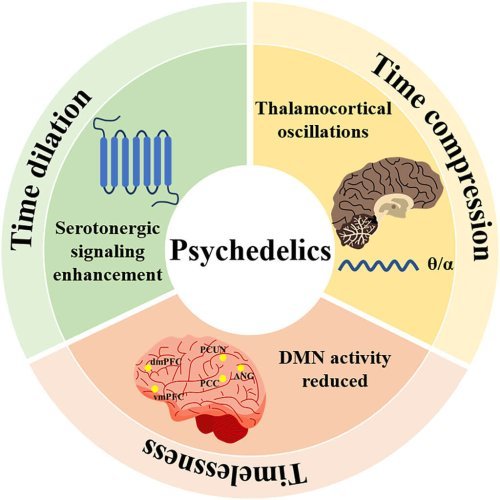
Typically speaking, psychedelics make users experience a slowing down of time— this change is attributed to increase sensory processing, as psychedelics elevate neural oscillations in lower brain regions, which are responsible for sensory input and emotional processing.
Additionally, the augmented attention to sensory stimuli during a trip can also interfere with time perception as the brain attempts to process information at a higher rate.
But on the other side of the coin, some people describe hours passing like minutes. This could be linked to what the psychonaut community calls “ego dissolution,” which can loosen someone’s perception of time. For this reason, it’s believed that time compression could be caused by the alteration in serotonin levels and consequent effect on the cortical activity via the 5-HT2A receptor.
The third-mentioned hypothesis is the effect of timelessness itself, a complete dissociation of the passage of time, once this happens, users typically describe profound or mystical experiences, and it’s believed that this might be a products of changes in the default mode network (DMN) of the brain, as the default mode network is associated with self-referential thinking and perception of continuous time, its suppression during these altered states could result in the dissolution of time as a boundary, past, present and future are perceived as irrelevant or a unified moment.
As every human body reacts differently to these compounds and the sense of temporal distortions, these experiences can vary depending on the type/class of compound, dosage, and setting. Additionally, distinctions between compounds bring up the possibility that different pharmacological interactions could be the key to understanding such modifications to time perception, at least amongst psychedelics, demonstrating that the neural substrates that mediate these experiences are multifaceted.
Such alteration in the perception of time while in psychedelic states could provide a novel perspective to study the brain mechanisms in temporal processing, and pave new perspectives for the study of the role of consciousness and its influence in what we consider reality.
But first, we must address the big elephant in the room: How do psychedelics alter our perception of time?
Our ability to understand time perception is influenced by the activity of distributed brain regions, neurotransmitters, and neural synchrony.
Basal ganglia:
- Implicated in interval timing on the scale of hundreds of milliseconds, functioning as a putative internal clock, generating temporal predictions based on sensory evidence.
Prefrontal Cortex:
- Encodes longer time spans and combines information for planning and making decisions. Crucial for controlling dynamic time-based tasks.
Cerebellum:
- Refines motor coordination and precise timing by integrating sensory input and motor output for precise timing events.
- By integrating interception of internal body states with cognitive perception, the insula has a modulating role in how emotions and somatic sensations shape our perception of time.
These processes are further regulated by major neurotransmitter systems.
Dopamine:
- Acts primarily through the basal ganglia and modulates short-interval timing.
- Dysregulation is linked to timing deficits.
Serotonin (particularly via the 5HT2A receptor activation):
- Influences longer time scales.
- Is the primary mediator of psychedelic-induced time distortions
- Interfacing emotional and sensory processing with subjective time experience.
Glutamate (largely through the NMDA receptor-mediated neurotransmission):
- Supports the neural encoding and maintenance of precise temporal representations needed for various cognitive tasks.
Write with us
Our mission is to educate about psychedelics. Whether you’re sharing your personal journey, exploring science, or crafting tales of transformation, your voice matters here!
In order to have a precise time perception, there must be a temporal coordination of neural activity between distant brain areas (generally mediated by neural synchrony), almost like a neurobiological orchestra within our body; these rhythms allow the synchronicity of sensory, motor, and cognitive activities.
Once we disrupt the synchronicity, it may result in a distorted perception of time.
This is exactly what happens when we take a psychedelic compound: it strongly affects the rhythm of this orchestra, resulting in the disrupted time perception due to the modulation of the brain’s sensory, calm, and self-reference system. One key factor for the mediating role of these changes is the Default Mode Network (DMN), comprised of:
- Medial prefrontal cortex,
- Posterior cingulate
- Angular gyrus
Related to self-referential thinking and the brain’s internal model of time, it is suppressed by psychedelics, correlating strongly with subjective reports of time dissolution and the loss of linear time perception.
These compounds also modulate cortical oscillations in the theta and alpha range (read more here), where the integration of sensory information over time is important. Modulations of these oscillations can result in dissonance between sensory inputs and the brain’s temporal predictions, thus inducing perceptions of time dilation or compression. The thalamus, an important relay center for sensory information, is also essential for temporal processing. When psychedelics modulate thalamic activity, disrupting the synchronization of sensory inputs, they may result in time dilation, compression, or even timelessness.
5-HT2A receptor in time perception:
When we speak about psychedelics, the most predominant receptor that comes to mind is the 5-HT2A receptor, the same receptor that plays a crucial role in psychedelic modulation of time perception.
The activation of the 5-HT2A receptor enhances cortical excitability and increases the gain on sensory inputs, shifting perception towards bottom-up evidence and making temporal cues that aren’t usually salient. Such network-level changes bias temporal processing and can appear as time dilation or compression.
But how does this happen?
Membrane-receptor signaling propagates via PLC-IP₃/Ca²⁺, β-arrestin/ERK, and CaMKII pathways in order to influence mitochondrial fission and fusion and overall bioenergetics, tune the endoplasmic-reticulum Ca²⁺ handling and endoplasmic reticulum-mitochondria contact sites, which shape integration windows, and organize the actin cytoskeleton through Rho GTPases, hence, modulating spine dynamics, synaptic integration and neural excitability.
By simultaneously turning excitability, temporal integration, and oscillatory synchrony, these subcellular processes make a mechanical bridge between receptor pharmacology and the neural coding of duration and sequence. At a system level, these compounds also attenuate prefrontal top-down constraints on sensory cortices, disrupting hierarchical inference and thalamocortical gating, thus weakening the brain’s capacity to bind events into a coherent temporal narrative.
Have a safer trip with Miraculix
How can our understanding of psychedelic-induced temporal distortions help in therapy?
Understanding the shift in time perception during psychedelic states can be an incredible tool for therapy in the mental health disorder field, such as depression, anxiety, PTSD, or addiction. As psychedelics modulate passage-time experiences, triggering insights, emotional catharsis, and cognitive re-contextualization, which are often considered crucial elements to healing.
One of the most predominant therapeutic applications of psychedelics lies in the reprocessing of traumatic memories, as during psychedelic states, individuals are able to revisit traumatic experiences/events from a detached, nonlinear perspective. This dissociation helps people process previous experiences with reduced emotional intensity, supporting meaning-making and integration of traumatic memories (in cases of PTSD). Such experiences of temporal decoupling are understood in part through the suppression of the Default Mode Network and altered connectivity with limbic structure.
Such temporary time distortions induced by psychedelics could also promote other forms of psychological healing by disrupting our patterns of thought, allowing new angles on emotional trauma and cognitive structures to be processed, updated, and integrated in more insightful and forgiving ways, thus impacting a different relationship in people that feel trapped in negative time loops or oppressed by impeding hopelessness such as cases of depression and anxiety.
Additionally, these states help understanding mental illnesses involving distortions of the sense of time, as by altering time perception, they present an opportunity to study the neural and cognitive processes of time disruption by their drug-induced modulation in conditions such as schizophrenia and PTSD. By providing the right set and setting, psychedelics may do the work of rewiring neural circuits implicated in time processing and emotion regulation, and so lead to more adaptive time perception.
While the impact of manipulating time perception is not fully understood in the therapeutic setting, we can deduce that psychedelics could enable the reprocessing of traumatic experiences, accelerate traumatic resolution, and open avenues to new paradigms of mental health disorders that have time perception at their core.
We need your help
We are currently working on our second book, Entheogenic Synergy. To do so, we need your help. By sharing your psychedelic experience, you will be helping us immensely with our study to prove the theory that external factors before the psychedelic experience can impact the way we trip. You can share your psychedelic experience by accessing our form.

About the author
Goncalo V
References: