
March 2026

Eleusis the first luxury psychedelic retreat is hosting DMTx, here is what you need to know
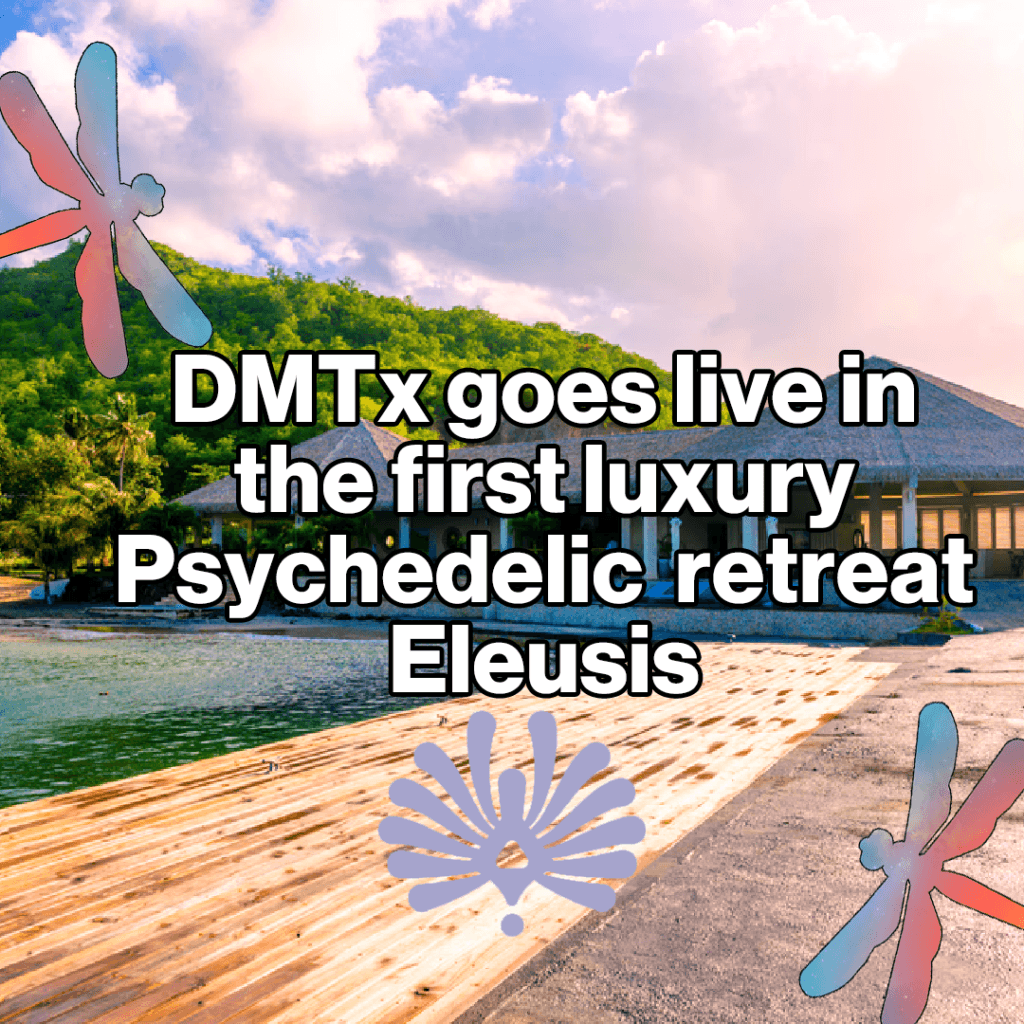
Eleusis the first luxury psychedelic retreat is hosting DMTx, here is what you need to know!​

Eleusis the first luxury psychedelic retreat is hosting DMTx, here is what you need to know! By Goncalo V. What if we could further explore DMT realms in more depth? Understand who these entities are and why we see them in the DMT experiences, and uncover why so many people experience witnessing entities on DMT in comparison to when taking other compounds. What if DMT is a vortex to another reality hidden within our brains? These were all questions fomented to create Eleusis, following the research model for the Application of Target-Controlled Intravenous Infusion for a Prolonged Immersive DMT Psychedelic Experience (DMTx) by Dr.Andrew Gallimore and Rick Strassman. This model uses target-controlled intravenous infusion (TCII), a technique commonly used in anesthesia to maintain a stable drug concentration in the brain. By leveraging pharmacokinetic modeling and DMT blood sampling data, the researchers demonstrated that DMT’s rapid onset and lack of acute tolerance would make the compound suitable for TCII. Allowing patients to have a prolonged DMT experience enables detailed observation and analysis of its psychological effects. Eleusis will debut this month on the island of Bequia in Saint Vincent and the Grenadines, thus becoming a new mecca for the study of DMT and DMTx, alongside Dr. Andrew Gallimore, Dennis McKenna, Graham Hancock, and other personalities.   What is DMT, and what is its history?   Until the 1960s, DMT was an obscure compound in Western society, despite its use dating back to circa 900 CE by the Tiwanaku, one of the most significant Andean civilizations. In 1931, the compound entered Western civilizations. Richard Manske was responsible for first studying DMT when searching for derivatives of N-methyltryptamines. However, the effects of the compound were only observed years later by Stephen Szara, after he extracted the compound from Mimosa Hostilis root bark and injected it into himself. Such research brought attention to various minds, such as the McKenna brothers, Dennis and Terence McKenna, Terence who ended up pioneering the experiences of DMT in the psychonaut community through his lectures and description of machine elves, fractals, alien patterns, during the ’60s, followed by various reports of psychonauts claiming to have seen various fractals, aliens, or even religious figures that would give them alien knowledge about the world, or give them answers (read more about DMT here).  Stanislav Grof and Wim Hof developed breathing techniques meant to increase the biosynthesis of DMT in the body. Rick Strassman opened the doors to research and literary piece “DMT: Spirit Molecule”, and lately, Andrew Gallimore followed up with his work on DMT alien worlds and DMTx alongside a broad team Show your love for the spirit molecule Apparel DMT: Consciousness Expedition Unisex T-Shirt $45.00 Apparel DMT: Consciousness Expedition Unisex Sweatshirt $65.00 Apparel DMT: Consciousness Expedition Unisex Hoodie $80.00 Apparel DMT Shulgin Handwritten Molecule Dad hat $45.00 Getting to the bottom of the question. Is DMTx safe? Eleusis has safety as its highest priority. To achieve this, they have a few bullet points to ensure the safety of their patients: If a patient feels uncomfortable or wishes to end their journey, the clinical team can stop the infusion. After the infusion is stopped, the experience will stop within minutes, allowing people to return to their normal state quickly and safely. Every session is medically supervised by physicians and clinical staff with advanced monitoring and immediate support. Their protocols are conducted with a fully legal framework and high standards of integrity and care. Sessions include thorough pre-retreat health and psychiatric screening, personalized preparation, and ongoing integration support. (Read more about the importance of set and setting here.) While Eleusis provides such points for the DMTx experiences of their patients, we must note that DMT is not a perfect molecule that is or should be experienced by everyone. Below, we will give you some examples of some occasions when you should avoid a DMT experience or discuss the idea with your doctor before embarking on your DMTx journey: Individuals with Certain Pre-existing Mental Health Conditions (such as schizophrenia, or Bipolar I Disorder, or who have first-degree relatives with these psychiatric conditions.) Individuals on Certain Medications or Drugs (for example, SSRIs) Immunocompromised Individuals (for example, cardiovascular disease) Pregnant or Breastfeeding Individuals Have a safer trip with Miraculix Buy your test kit here   The team:   Eleusis is composed of some familiar faces if you’ve been in the psychedelic space for some time. Some we’ve previously mentioned in this and other articles, such as Dr. Andrew Gallimore and Dr. Chris Timmermann, but there are far more familiar faces that constitute the Eleusis team, Bianca Abbott, Carl Hayden Smith, Dr. Murray Heber, and Dr. Andrew Ferber in the medical and R&D departments. Ian Mccal, Michael Smith, Jordan Poyer, Michael Gonzales, Savej, Chris Dyer, and WALLY are the program leaders and advisors. The Executive Team was formed by Angus Taylor, Craig Strenhouse, Christina Thomas, Charles Patti, and Kirstie Wilkins. (You can meet the Eleusis team here: https://eleusismind.com/about)   Outside of the trip: The six-day experience at Eleusis is fully inclusive, allowing you to focus on your DMTx experience and make the most of it to heal and explore the human mind. Covering comprehensive medical and psychiatric screening using tools such as: HUME band and bimetric data Personalized integration Pre-retreat materials 3 DMTx experiences Daily group integration Yoga sessions Meditation Luxury accommodation in private villas or suites Gourmet, organic meals and beverages 4 weeks of post-retreat integration calls (learn about the importance of integration in our interview with Dr. Victoria Sterkin) Guests with limited availability can also book a fully inclusive 4-day experience that includes two DMTx experiences. For those interested in DMTx, you may follow this link to book a call with the team and apply for the retreat: https://form.jotform.com/250685241546156 For more information about Eleusis, follow this link: https://eleusismind.com/ As always, stay safe, sending love. About the author Goncalo V Goncalo V. founded Psychedelics As a Second Language (PsychedelicsASL) in 2021 with the aim of making psychedelic science available and understandable for everyone,
Eleusis the first luxury psychedelic retreat is hosting DMTx, here is what you need to know Read More »

Why Do Psychedelics Alter Time Perception? The Neuroscience Explained

Why do psychedelics alter our perception of time, and how could that affect Psychedelic therapy?

Why Do Psychedelics Alter Time Perception? The Neuroscience Explained By Goncalo V. Time perception is potentially one of the most present skills in our day to day, we’re constantly aware of time during our circadian routine, whether it’s to enter our routine or finish our day, yet this is only part of what time perception actually does in our life, time perception has profound effects on human consciousness, influencing cognition, affect regulation and behavior. Typically speaking, we perceive life as a continuous timeline — yet, the perception of time allows us to determine how we perceive the past, present, and future, thus affecting our sense of self and what is real. However, when someone consumes a psychedelic compound like DMT, LSD, or even Salvia Divinorum, their perception of time can change to the point where they claim to believe that they’ve experienced hours, and sometimes even decades of their life, or even eternity when tripping, a phenomenon known as time dilation. Such distortions in the perception of time offer us insight into how the brain processes time. They disrupt the assumptions of traditional models of consciousness. This reminds us how something as essential as time can be. What happens to our brain when we lose perception of time is where things become interesting. To understand more about how the perception of time changes between psychedelic experiences, we will go through three typical scenarios reported by the psychedelic community. Slowing down of time Speeding up time Feeling of Timeless/Eternity The perfect choice for those who love exploring the mind Apparel Exploring the Mind Embroidered Vintage corduroy cap $45.00 Apparel Exploring the Mind Embroidered Unisex Hoodie $80.00 Apparel Exploring the Mind Embroidered Unisex Sweatshirt $65.00 Apparel Exploring the Mind Embroidered Short-Sleeve Unisex T-Shirt $45.00 Typically speaking, psychedelics make users experience a slowing down of time— this change is attributed to increase sensory processing, as psychedelics elevate neural oscillations in lower brain regions, which are responsible for sensory input and emotional processing. Additionally, the augmented attention to sensory stimuli during a trip can also interfere with time perception as the brain attempts to process information at a higher rate. But on the other side of the coin, some people describe hours passing like minutes. This could be linked to what the psychonaut community calls “ego dissolution,” which can loosen someone’s perception of time. For this reason, it’s believed that time compression could be caused by the alteration in serotonin levels and consequent effect on the cortical activity via the 5-HT2A receptor. The third-mentioned hypothesis is the effect of timelessness itself, a complete dissociation of the passage of time, once this happens, users typically describe profound or mystical experiences, and it’s believed that this might be a products of changes in the default mode network (DMN) of the brain, as the default mode network is associated with self-referential thinking and perception of continuous time, its suppression during these altered states could result in the dissolution of time as a boundary, past, present and future are perceived as irrelevant or a unified moment. As every human body reacts differently to these compounds and the sense of temporal distortions, these experiences can vary depending on the type/class of compound, dosage, and setting. Additionally, distinctions between compounds bring up the possibility that different pharmacological interactions could be the key to understanding such modifications to time perception, at least amongst psychedelics, demonstrating that the neural substrates that mediate these experiences are multifaceted. Such alteration in the perception of time while in psychedelic states could provide a novel perspective to study the brain mechanisms in temporal processing, and pave new perspectives for the study of the role of consciousness and its influence in what we consider reality. But first, we must address the big elephant in the room: How do psychedelics alter our perception of time? Our ability to understand time perception is influenced by the activity of distributed brain regions, neurotransmitters, and neural synchrony. Basal ganglia: Implicated in interval timing on the scale of hundreds of milliseconds, functioning as a putative internal clock, generating temporal predictions based on sensory evidence.   Prefrontal Cortex: Encodes longer time spans and combines information for planning and making decisions. Crucial for controlling dynamic time-based tasks.   Cerebellum: Refines motor coordination and precise timing by integrating sensory input and motor output for precise timing events. By integrating interception of internal body states with cognitive perception, the insula has a modulating role in how emotions and somatic sensations shape our perception of time. Neurobiological mechanisms of psychedelic-induced time perception alterations.   These processes are further regulated by major neurotransmitter systems. Dopamine: Acts primarily through the basal ganglia and modulates short-interval timing. Dysregulation is linked to timing deficits.   Serotonin (particularly via the 5HT2A receptor activation): Influences longer time scales. Is the primary mediator of psychedelic-induced time distortions Interfacing emotional and sensory processing with subjective time experience.   Glutamate (largely through the NMDA receptor-mediated neurotransmission): Supports the neural encoding and maintenance of precise temporal representations needed for various cognitive tasks. Write with us Our mission is to educate about psychedelics. Whether you’re sharing your personal journey, exploring science, or crafting tales of transformation, your voice matters here! Pitch us your idea via email In order to have a precise time perception, there must be a temporal coordination of neural activity between distant brain areas (generally mediated by neural synchrony), almost like a neurobiological orchestra within our body; these rhythms allow the synchronicity of sensory, motor, and cognitive activities. Once we disrupt the synchronicity, it may result in a distorted perception of time. This is exactly what happens when we take a psychedelic compound: it strongly affects the rhythm of this orchestra, resulting in the disrupted time perception due to the modulation of the brain’s sensory, calm, and self-reference system. One key factor for the mediating role of these changes is the Default Mode Network (DMN), comprised of: Medial prefrontal cortex, Posterior cingulate Angular gyrus Related to self-referential thinking and the brain’s internal model of time,

Why Do Psychedelics Alter Time Perception? The Neuroscience Explained Read More »

Shopping Cart