Amanita Muscaria In a nutshell: The cultural impact of the fly agaric
Fungi are all around the world, paving Earth through mycelial networks. Some fungi remain obscure due to their rare nature. Meanwhile, some became nurtured by our society and vividly present in our culture and traditions as well as a representative of the mushroom kingdom. We are talking about the unique and fascinating Amanita Muscaria.
The historical use of Amanita still roams slightly on the mysterious side, as R. Gordon Wasson theorizes that the Soma drink mentioned in the Vedic Sanskrit hymn Rig Veda might be Amanita Muscaria. If this theory is correct, this would mean that the mushroom has been used for around 4000 years.
Unfortunately, we still lack evidence, leaving us with the only historically accurate use of this mushroom amongst the Fino-Ungarians in Siberia.
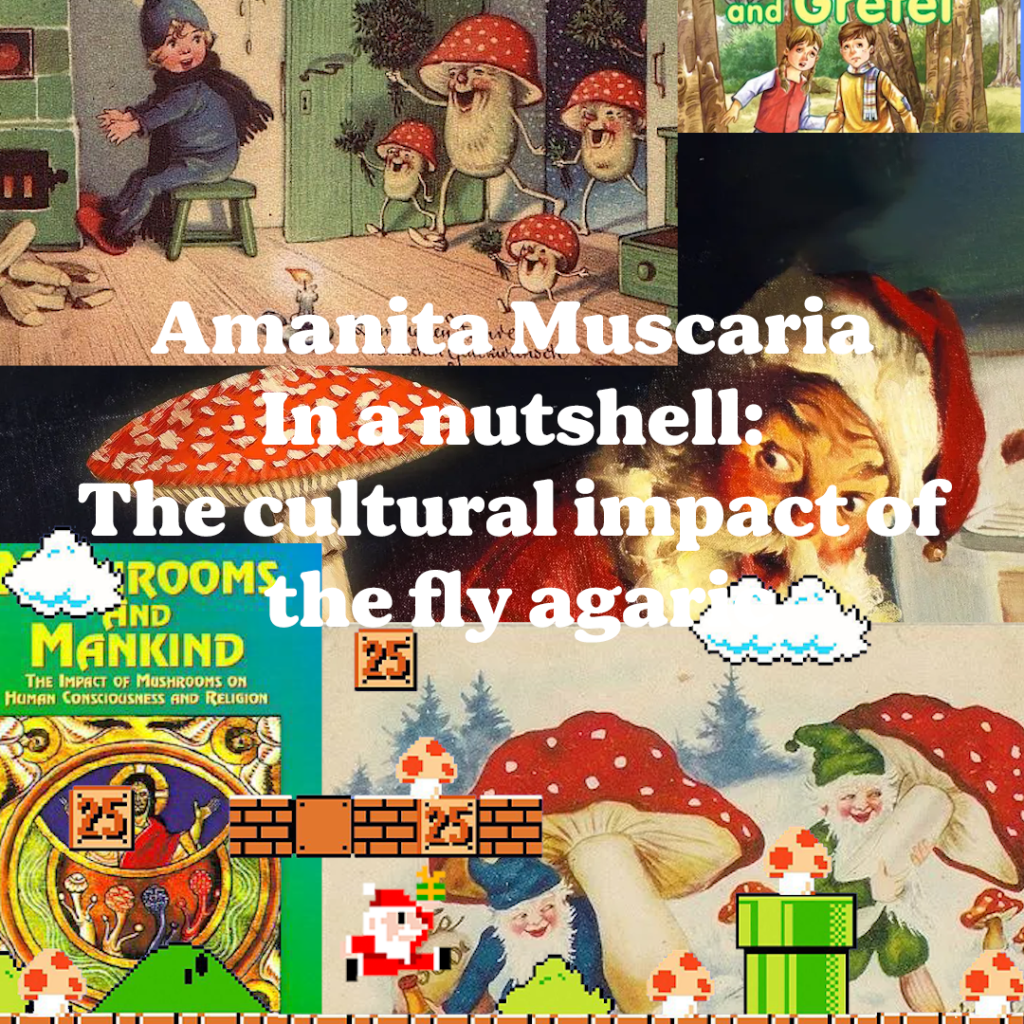
Amanita Muscaria would soon expand and become engrained in our culture until today, being present in children’s books, playgrounds, cartoons, riddles, and video games.
Amanita’s cultural impact goes even beyond when Jonathan Ott linked this mushroom and Christmas, relating the red and white pattern of Amanita with the clothing pattern of Saint Nicholas (Santa Claus) and the flying reindeer with ingesting the reindeer urine after they had eaten the mushroom by tribes in Siberia. Flying reindeer could also represent the reindeer that ate the mushroom.
James Arthur marked these links even further in his book Mushrooms and Mankind, linking the Christmas tree and gifts wrapped in red and white below the tree to the symbiosis between the roots of coniferous trees and the mycelial networks of the Amanita Muscaria shroom.
Regardless of its continuous presence in Children’s tales, don’t be mistaken. This mushroom is no child’s play.
Throughout time, the discussion regarding the toxicity of Amanita Muscaria has been continuous. Some believe that the fungus is poisonous due to containing the neurotoxin ibotenic acid. Meanwhile, others say that the mushroom is safe after being prepared correctly, and some go further and say that eating the mushroom without any preparation is safe.
Contrary to popular belief, Amanita Muscaria has no resemblance to other magic mushrooms and works in a completely different way.
Unlike the psilocybe genus, the fly agaric doesn’t have psilocybin or any serotonergic compound. Instead, the mushroom contains muscarine and muscimol.
Muscimol, also known as agarin or pantherine, works very differently from classic psychedelics. The compound is a potent GABA-A agonist, acting as an oneirogen (sedative/hypnotic), subjectively similar to the hypnotic drug Ambien (Zolpidem).
Amanita Muscaria In a nutshell: The cultural impact of the fly agaric Read More »