Magic Mushrooms grow all over the globe and are one of the most well-known naturally occurring psychedelic compounds. As a synthetic counterpart, the most well-known compound is LSD. While many compare the experiences between LSD and Psilocybin, it’s important to question: “What is the difference between these two compounds?”
Both compounds belong to the class of “classic psychedelics”, but it’s important to understand what this means.
Classic psychedelics such as LSD and Psilocybin are partial or full agonists at the serotonin receptor in the brain. Both are believed to act on 5-HT2A serotonin receptors in the frontal and visual cortex, limbic system, and basal ganglia, generating effects on cognition, vision, and integration. These effects on serotonin have also led to some concern regarding serotonin syndrome in people who have used these compounds and are currently on antidepressants. Yet, the link between psychedelics and serotonin syndrome is unclear, and some experts believe there’s very little risk of this happening. However, taking MDMA and/or MAOIs is known to increase the risk.
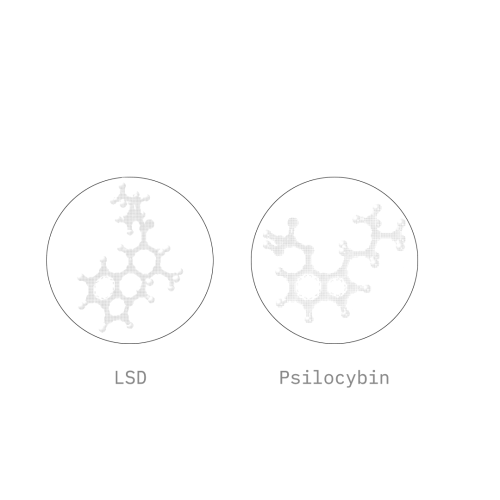
Chemical differences between LSD and Psilocybin:
LSD has a unique structure. Although the compound belongs to the lysergamide family, it contains both a tryptamine and a phenethylamine backbone.
Ergoline Core: LSD belongs to the class of compounds known as ergolines, which are rigid ring systems. (The ergoline backbone are uniquely non-selective. LSD binds with high affinity to almost an entire spectrum of serotonin receptors, while also engaging dopamine (D1, D2, D3) and adrenergic (α₁, α₂) receptors. This cross-system explains why the effects of LSD feel distinct from pure tryptamines or phenethylamines.
Tryptamine Fragment: Its structure includes an indole ring attached to an ethylamine chain, mirroring the layout of DMT, other tryptamine based psychedelics and the natural neurotransmitter serotonin. (Usually narrow profile of serotonin 5-HT receptors).
Phenethylamine Fragment: Its molecular structure also embeds a phenethylamine-like orientation. (Tend to be highly selective for the 5-HT2 family.
These different backbone structures within the ergoline framework makes the pharmacodynamics of LSD highly unique!
On the other hand, Psilocybin’s chemistry is much simpler. The compound is a tryptamine alkaloid (hence its chemical name, 4-phosphoryloxy-N, N-dimethyltryptamine). However, psilocybin itself is just a prodrug for the compound that becomes active once we ingest it and metabolize for example, in magic mushrooms, psilocybin is rapidly metabolized to psilocin, which mainly targets serotonin receptors, mostly the 5-HT2A receptor but also binds to other serotonin subtypes such as 5-HT1A, 5-HT2C, and 5-HT₁D.
Influence of Albert Hofmann in LSD and Psilocybin:
Albert Hofmann, a Swiss chemist, was the first to synthesize LSD in 1938 when researching derivatives of ergot alkaloids and discovered its psychoactive properties in 1943, giving birth to the psychedelic event Bicycle Day. (Learn more about Hofmann’s Discovery of LSD here!)
While many have heard this history, not many people know that Albert Hofmann was also involved when it came to researching Psilocybin, as in 1958, while still working at Sandoz, Hofmann isolated, named, synthesized, and self-experimented with psilocybin and psilocin after R. Gordon Wasson brought Psilocybe Mexicana back from Mexico in 1955. During the 1950s and 1960s, Sandoz manufactured and distributed psilocybin under the brand name Indocybin. The compound was sold to physicians and researchers worldwide for experimental psychedelic-assisted psychotherapy. Production was stopped in 1965 due to increasing international political backlash and tightened drug regulations.
The physical effects of LSD are unpredictable from person to person. But usually, the first effects occur 30 to 45 minutes after oral ingestion, peak 2 to 4 hours later, and may last 12 hours or longer. The effects include:
Hallucinations
Distorted visual perception of shapes and colors
Altered sounds
Anxiety and depression
Flashbacks (a return of the “trip” experience) days or months later
Rapid heart rate, increased body temperature, and high blood pressure
Dilated pupils
LSD trips are often described as sharp and fast-moving; thoughts can jump from topic to topic, and perspective feels wide awake, clear, and focused on the external environment or abstract concepts.
LSD trips can feel harder to steer if you want the experience to slow down.
Psilocybin:
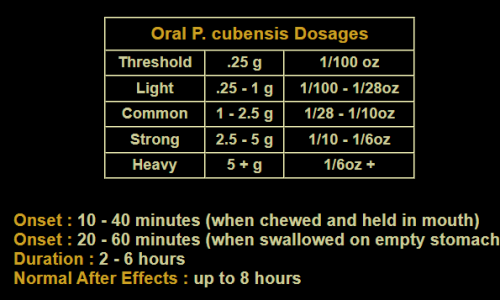
Like LSD, the effects of Psilocybin are unpredictable from person to person. But usually, the first effects occur 20 to 40 minutes after oral ingestion, peak 1 to 2 hours later, and may last 4 to 6 hours. The effects include:
Hallucinations
Distorted visual perception of shapes and colors
Altered sounds
Anxiety and depression
Flashbacks (a return of the “trip” experience) days or months later
Rapid heart rate, increased body temperature, and high blood pressure
Dilated pupils
Psilocybin can make users feel heavier and want to lie down, rest, or close their eyes.
Psilocybin trips are usually more emotional, dreamy, and deeply personal, focused inward on memories, feelings, nature, and a sense of connection to the self or universe.
Psilocybin comes in waves, meaning the intensity ebbs and flows more noticeably before fading out.
Goncalo V. founded Psychedelics As a Second Language (PsychedelicsASL) in 2021 with the aim of making psychedelic science available and understandable for everyone, regardless of their background and scientific knowledge. Since then, he has interviewed various guests within the psychedelic field, including artists, psychedelic entrepreneurs, chemists, psychedelic researchers, therapists, and students, all with one goal. To give you an organic and raw experience of what is going on in the psychedelic field. From experimental science to well-established research, everything can be valued in his eyes (of course, as long as it’s in the legal spectrum).